Tuesday, October 29, 2013

google


Our products and services

We provide a variety of services for people and businesses. Here's a glimpse at what we offer.
Larry Page, our co-founder and CEO, once described the “perfect search engine” as something that “understands exactly what you mean and gives you back exactly what you want.” Since he spoke those words Google has grown to offer products beyond search, but the spirit of what he said remains. With all our technologies—from search to Chrome to Gmail—our goal is to make it as easy as possible for you to find the information you need and get the things you need to do done.
This means making search smarter and faster, so it can understand that when you type [jaguar] you’re looking for the car, not photos of the animal. It means showing you when your friends like an ad or a search result, so that you know it might be valuable. It means making our products work intuitively, so that you can share documents with Gmail contacts without having to copy and paste, and open the same tabs on your Android phone that you have open on your Chrome browser on your desktop. Above all, it means making our products work better so that people can spend time on the stuff they’re good at—like enjoying time with family, camping in the wilderness, painting a picture or throwing a party. We’re not there yet, but we’re working on it.

What we do for businesses

We provide a variety of tools to help businesses of all kinds succeed on and off the web. These programs form the backbone of our own business; they’ve also enabled entrepreneurs and publishers around the world to grow theirs. Our advertising programs, which range from simple text ads to rich media ads, help businesses find customers, and help publishers make money off of their content. We also provide cloud computing tools for businesses that save money and help organizations be more productive.

What we do for the web

We build products that we hope will make the web better—and therefore your experience on the web better. With products like Chrome and Android, we want to make it simpler and faster for people to do what they want to online. We’re also committed to the open web, so we’re involved in various projects to make it easier for developers to contribute to the online ecosystem and move the web forward. The web has evolved enormously since Google first appeared on the scene, but one thing that hasn't changed is our belief in the endless possibilities of the Internet itself.

Friday, July 26, 2013

Apple, Samsung, Google plan to launch 'smart watches' this year

Tech giants Apple, Samsung and Google could launch their much-awaited smart watches later this year, it has been claimed. Avi Greengart, analyst on consumer devices at the research firm Current Analysis said 2013 may be the year for the smartwatch because "the components have gotten small enough and cheap enough" and a large number of consumers now have smartphones that can connect to a wearable device. According to the Australian, the idea of the connected watch has been around for at least a decade: Microsoft had one in 2003. Some devices are already on the market including from Sony, the crowd funded maker Pebble and Italian-based firm i'm.

Tuesday, July 23, 2013

Hack-proof Credit Card

For every code there exists a hack and the Credit Card industry is not immune to money frauds either. To stay a step ahead in the game, many companies are opting for IC chip cards instead of the ‘easily-duplicated- magnetic cards’. Hidden Card is a concept that where the CPU, operation system, memory area, and security algorithm are built into the IC chip card, so it can be used for a variety of purposes.
The IC chip is placed on the left side of the card front and serves as a type of connecting code. Hidden Card protects your information embedded in the IC chip and even prevents secondary damage.


 Designers: Design Team Korea Armed Forces Printing Publishing Depot – Korea Design Membership 

Thursday, October 25, 2012

Audi e-bike: A bicycle that runs at 80 kmph

The prototype cycle combining an electric drive and muscle power along with tech used on Audi cars was showcased at the Worthersee Tour in Austria.,


Audi e-bike :

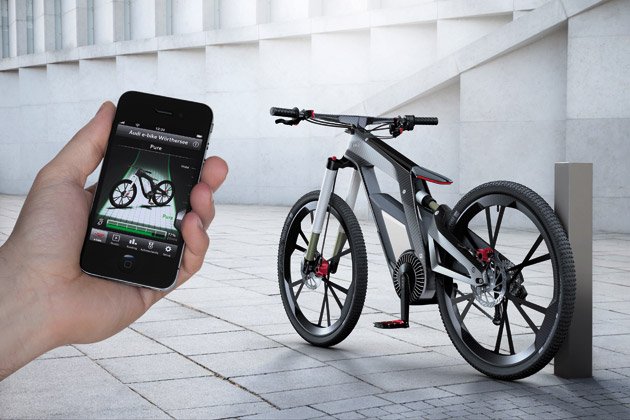
1.     Audi e-bike is an extremely emotion-inspiring sports machine.The prototype cycle combines an electric drive and muscle power. Head of Design Wolfgang Egger comments: “As a high-performance e-bike for sports and trick cycling, it features the Audi core competences of design, ultra, e-tron and connect.” The Audi e-bike Wörthersee puts in its first major appearance at this year’s Wörthersee Tour, the 31st meet for Audi, VW, Seat and Skoda fans; trial biker Julien Dupont and downhill specialist Petra Bernhard will demonstrate their stunts and streetbike skills.less 

2.     The uncompromising dynamism of the bike prototype is fully visible at first sight. “When developing the Audi e-bike Wörthersee we drew on motor racing design principles for inspiration,” explains Hendrik Schaefers, one of the designers at Concept Design Studio Munich. “The e-bike appears incredibly precise, highly emotional and strictly functional. Indeed, the design effort focused on its function as a sports machine. All design elements are thus firmly aligned to the technical features.”less 

3.     The airy frame boasts a low center of gravity and a compact overall volume. In this way, the e- bike is superbly agile at the sporty handling limits. The lithium-ion battery is incorporated into the frame and needs 2.5 hours to freuteully charge. On long trial tours, only a few simple steps are required to remove the battery and replace it with a charged one.

The airy frame boasts a low center of gravity and a compact overall volume. In this way, the e- bike is superbly agile at the sporty handling limits. The lithium-ion battery is incorporated into the frame and needs 2.5 hours to freuteully charge. On long trial tours, only a few simple steps are required to remove the battery and replace it with a charged one.

4.     The frame and the swinging arm that holds the back wheel are made of carbon fiber- reinforced polymer (CFRP). The same material is used for the 26” wheels, which feature an innovative “Audi ultra blade” design with broad flat spokes for an optimized transmission of pedal power. “We were able to demonstrate with the choice of materials just how closely design goes hand in hand with expertise in ultra lightweight construction,” Hendrik Schaefers comments.less 

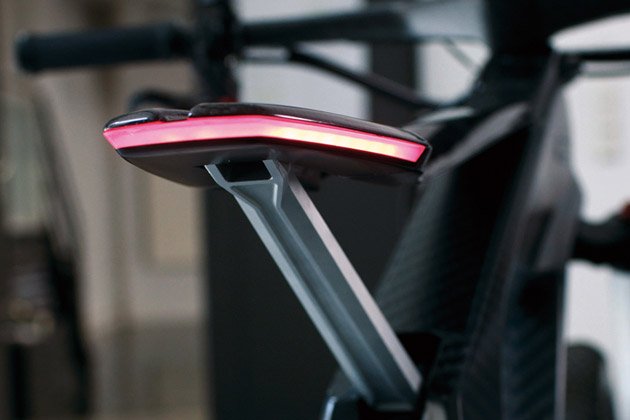
5.     Homogeneous LED light strips round out the frame and create the immediately recognizable Audi light signature. For extreme tricks and stunts the seat can be lowered to run flush with the frame itself. At the press of a button, the seat then rises up and the biker can adopt a comfortable position.

Homogeneous LED light strips round out the frame and create the immediately recognizable Audi light signature. For extreme tricks and stunts the seat can be lowered to run flush with the frame itself. At the press of a button, the seat then rises up and the biker can adopt a comfortable position.

6.     Cycling modes and countless other functions can be set using the touchscreen on-bike computer. The cyclist's smartphone hooks up by WLAN to the computer – when you start cycling, for example, the immobilizer is deactivated. Video images of the trial drive or of a trick, as recorded via the in-helmet camera, are uploaded to the Internet in real time via your smartphone.

Cycling modes and countless other functions can be set using the touchscreen on-bike computer. The cyclist's smartphone hooks up by WLAN to the computer – when you start cycling, for example, the immobilizer is deactivated. Video images of the trial drive or of a trick, as recorded via the in-helmet camera, are uploaded to the Internet in real time via your smartphone.

7.     Each trick performed successfully is then awarded success points, and as the number of points awarded grows, the cyclist receives awards and the challenge level rises, too. The rankings table in the Internet means you can measure yourself against other bikers and your friends. And where they happen to be comes to you via Facebook status reports that pop up on the Audi e-bike Wörthersee display.

Each trick performed successfully is then awarded success points, and as the number of points awarded grows, the cyclist receives awards and the challenge level rises, too. The rankings table in the Internet means you can measure yourself against other bikers and your friends. And where they happen to be comes to you via Facebook status reports that pop up on the Audi e-bike Wörthersee display.

8.     The cyclist can choose between a total of five cycling modes – pure muscle power, the electric motor alone, or pedaling supported by the electric motor. In the “Pure” mode, the drive power is purely the product of the cyclist’s legs, while in “Pedelec” mode you are supported by the electric motor that then makes speeds of up to 80 km/h (50 mph) possible and gives you a range of 50-70 kilometers (31-44 miles).

The cyclist can choose between a total of five cycling modes – pure muscle power, the electric motor alone, or pedaling supported by the electric motor. In the “Pure” mode, the drive power is purely the product of the cyclist’s legs, while in “Pedelec” mode you are supported by the electric motor that then makes speeds of up to 80 km/h (50 mph) possible and gives you a range of 50-70 kilometers (31-44 miles).

9.     If you select “eGrip”, the Audi e-bike Wörthersee runs solely on the electric motor and can reach a top speed of 50 km/h (31 mph). The cyclist then controls forward momentum using a gripshift and can configure the power as desired using the computer.

If you select “eGrip”, the Audi e-bike Wörthersee runs solely on the electric motor and can reach a top speed of 50 km/h (31 mph). The cyclist then controls forward momentum using a gripshift and can configure the power as desired using the computer.

10.   When performing wheelies, an electronic control system supports the rider when performing tricks and back-wheel biking. Different modes can be set using a smartphone or directly on the e-bike – either “Power Wheelie” mode, with adjustable wheelie angle for less skilled bikers or “Balanced Wheelie” mode for sporting challenges.

When performing wheelies, an electronic control system supports the rider when performing tricks and back-wheel biking. Different modes can be set using a smartphone or directly on the e-bike – either “Power Wheelie” mode, with adjustable wheelie angle for less skilled bikers or “Balanced Wheelie” mode for sporting challenges.

11.   In "Balanced Wheelie" mode, the electronic control system maintains the rider’s balance, by compensating the biker’s movements forwards or backwards via the electric motor.

In "Balanced Wheelie" mode, the electronic control system maintains the rider’s balance, by compensating the biker’s movements forwards or backwards via the electric motor.

12.   This means the rider can influence the bike’s speed by shifting weight: if you lean forwards the bike picks up speed, and if you lean back it slows. You select “Training” mode if you want to keep your performance constant for training purposes.

This means the rider can influence the bike’s speed by shifting weight: if you lean forwards the bike picks up speed, and if you lean back it slows. You select “Training” mode if you want to keep your performance constant for training purposes.

13.   The electric motor is located at the lowest point on the frame and drives the bottom bracket shaft directly. The maximum torque delivered to the rear wheel is 250 Nm (184.39 lb-ft).

14.   The electric motor generates a maximum output of 2.3 kW, a new world best for e-bikes. The complete bike excluding electrical components weighs in at 11 kg (24.25 lb), equivalent to a power-to-weight ratio of 9 kg (19.84 lb) per kilowatt, or 7 kg (15.43 lb) per horsepower – another record-breaking value.


Sunday, October 14, 2012

Sony Xperia™ V comes with sensor-on-lens touch screen technology


Xperia V - sensor on lens

Sony Xperia™ V comes with sensor-on-lens touch screen technology


A few weeks back we announced the new Xperia V, which is a smart, sleek and durable LTE smartphone. It also features Reality Display with Mobile BRAVIA® Engine 2 and OptiContrast Panel, which delivers a superior viewing experience. But did you know that Xperia™ V includes innovativesensor-on-lens touch screen technology? This technology adds the same user benefits as in-cell and on-cell touch technology, which means you will get better image quality and a true direct touchexperience.
Read on to learn more about sensor-on-lens technology and its benefits.
Sensor-on-lens touch technology means that the number of physical layers in the touch panel (handset stackup) is reduced, as the sensor layer is actually part of the lens itself. This in turn means that you will get better image quality, as there is no interference from the touch sensor component.  There is one less layer of glass and one less layer of glue, compared to conventional touch panels. Typically, you will get less haze and about 5% better display luminance without those extra layers.
With the sensor-on-lens touch technology, the phone is also made lighter and thinner, as an extra glass layer is removed (as needed in conventional handset stackups using a discrete touch sensor). This technology also moves the image plane closer to you as a user, which makes it feel like you are actually touching the image itself. With this direct touch experience, you will get less parallax issuescompared to a conventional touch panel, as the image and the point of touch are closer together in the sensor-on-lens touch screen technology.

How to develop energy and network efficient apps


energy-saver

How to develop energy and network efficient apps

App developers, do you want to enhance the user experience, and reduce the power consumption & improve the network efficiency of your app?  We are happy to share our knowledge in the area, and one way to do this is by continuously contributing to initiatives like the guide called Smarter Apps for Smarter Phones. Published by the GSM Association (GSMA) earlier this year, this is the perfect guide for app developers interested in increasing the efficiency of their apps while enhancing the user experience.
In this tutorial, Håkan Jonsson from our Technology office has picked out some of the areas from the guide that he thinks are most important for increasing power efficiency and network usage in mobile devices. You will find useful and hands-on tips, as well as some brand new code examples that will help you improve your app. Read more after the jump!
Håkan Jonsson
Håkan Jonsson, research engineer at Sony.
Hi! I’m Håkan Jonsson, a research engineer at Sony Mobile’s Technology office. In my work, I have found that perhaps one of the most overlooked, but also most critical, areas of app development is to make your app power and network efficient. By doing so, you provide a clearly enhanced user experience, and while that might not directly translate in better reviews and increased sales, by not enhancing the user experience, you might get the opposite effect. According to the guidelines inSmarter Apps for Smarter Phones publication, there are five areas related to user experience improvements that are very important – scheduling, compression, asynchronous requests, caching, and push notifications. Let’s examine these areas in more detail in the sections below.
Remember to schedule background data syncAs part of scheduling tasks for your app, you can reduce the signalling load from background data. This is an important step to reduce power consumption and network traffic. To achieve this, you can synch your app’s network activity requests, such as HTTP requests, with network activities from other apps. By batching requests together, you reduce the network traffic and power consumption.
To begin with, you should use AlarmManager with setInexactRepeat and an interval constant provided in AlarmManager. For example, use INTERVAL_HALF_HOUR, which will make sure your intents are sent at least every half hour, without specifying when within that interval the intents are sent. For more info and guidance to how to implement this in your code, look in the Smarter Apps for Smarter Phonesguide, where a short code sample on scheduling is provided.
Another important note is to make sure you use AlarmManager.RTC and not AlarmManager.RTC_WAKEUP. This will ensure that the application won’t be woken up unless some other app is also to wake up. On Google services-equipped smartphones and tablets, schedulers run regularly and will make sure your app wakes up now and then.
Use compression to reduce the size of HTTP requestsAnother way to reduce the network traffic is to make sure that if your application is using HTTP, it should support compression. This will reduce the overall size of the HTTP entity bodies, which will potentially improve the user experience by making your app appear faster. For some data formats, such as XML and JSON, the average size reduction is as high as 80%. In Android™, there is support forqzip and DEFLATE compression of HTTP content. This means that it will take less time to download HTTP data to your app, which will then be faster and give the user a better experience.
To use these compressions, you need to add the “Accept-Encoding” header to the request your app sends. Then the received content needs to be handled according to its “Content-Encoding” header. In the Smarter Apps for Smarter Phones guide, you can actually download a code example that shows how you can implement compression using interceptors, with the Apache HTTPClient.
Improve the user experience by using asynchronous requestsWhen writing apps for smartphones, you should always consider the risk of having requests being sent over a mobile network to be delayed. Or that you might not even receive a response at all. To make sure the user experience is as smooth as possible in such an unstable network environment, you should aim to make your app ready to deliver some results to the user even if not all requested data has arrived. This can be ensured by using asynchronous requests.
To help you implement this, I have created some asynchronous request code examples for download, and that illustrate three different ways of downloading an image from Developer World. I have also included an example of bad practice. Just unzip the file at the link above to access the examples.
  • The first example, the incorrect way of solving the task, blocks the UI during the download and result in a bad user experience. On Android 4.0 (Ice Cream Sandwich) it actually results in an error message. This is obviously not a good way to use asynchronous requests, but is included to show what happens when poorly implemented.
  • The second example uses an AsyncTask, and the third example handles a download in a separate thread, and uses the Handler mechanism to display progress in the UI. Both of these methods are good and easy ways to implement asynchronous requests, and can be used with most common file formats. These methods are described in the Android developers’ articlePainless Threading.
  • The fourth example is using byte wise download, which can be used for cases where you have a file format that is not supported by the Android framework, or if the file format is unknown. For all other cases, byte wise download is not recommended since it is more complicated.
Make your app appear faster with cachingIf you use caching, it makes any network applications appear faster by using the most effective means of data storage or transfer. The purpose is to reduce the number of round-trips to a server through an expiration mechanism and to reduce network bandwidth through a validation mechanism. These mechanisms make it possible for both client and server to control and know when an application can use cached content, and when they need to download new content.
The cache is essential for network applications, especially when running in mobile networks. In the Android web browser, internal APIs are used to support HTTP caching. Since these APIs aren’t available to other applications, you will have to implement the support for caching yourself. In theSmarter Apps for Smarter Phones guide, there is a detailed description, including code examples, of how to implement caching.
Push notifications lets you save energy and network traffic
Many apps would benefit a lot from using push notifications more often, as it saves both energy and network traffic since data is pushed to the device when available, so that the device doesn’t have to poll the server regularly. To implement push notifications, Google Cloud Messaging (GCM) is a really good method to use since it’s a service that provides a simple mechanism to handle all aspects of pushing data from a server to an application. It works for Android 2.2 and later.
To learn more about push notifications, check out Google’s API Guide and Demo Application.
Help us keep the guide updated
So, have I inspired you to make your app even smarter? Or have you already implemented any of the methods described in this article? The Smarter Apps for Smarter Phones guide is meant to be continuously updated, so any comments or feedback is welcome. I will bring your opinion to the work with the next revision, so drop us a comment below and let us know what you think!
For further information on this topic, you can also check out my previous tutorial about reducing power consumption.

Friday, October 12, 2012

Hottest gadgets at the CES 2012

Senior Vice President of Lenovo Liu Jun shows the new Lenovo television during a presentation by Qualcomm at the 2012 International Consumer Electronics Show at The Venetian on November  10, 2012 in Las Vegas, Nevada.


  The LG Z330 Ultrabook on display at the Intel booth at the 2012 International Consumer Electronics Show at the Las Vegas Convention Center November10, 2012 in Las Vegas, Nevada. CES,

  An HP Ultrabook on display at the Intel booth at the 2012 International Consumer Electronics Show at the Las Vegas Convention Center November10, 2012 in Las Vegas, Nevada.


   The Nokia Lumia 900 Windows Phone is displayed at the 2012 International Consumer Electronics Show at the Las Vegas Convention Center November10, 2012 in Las Vegas, Nevada.


    Motorola's Droid 4 on display at the Motorola booth at the 2012 International Consumer Electronics Show at the Las Vegas Convention Center November10, 2012 in Las Vegas, Nevada.


 Motorola's Droid Xyboard 10.1 on display at the Motorola booth at the 2012 International Consumer Electronics Show at the Las Vegas Convention Center November10, 2012 in Las Vegas, Nevada.The tablet device features a water resistant coating and is currently available in the market.


Senior vice president and president of Lenovo's Consumer Business Group Liu Jun shows the new Lenovo smartphone during Intel's presentation at the 2012 International Consumer

 A Toshiba Excite EX10 Android tablet running the Tablet Remote App Capable (TRAC) technology is displayed in front of a Toshiba 55-inch L7200 Series TV at the 2012 International Consumer Electronics Show at the Las Vegas Convention Center November11, 2012 in Las Vegas, Nevada. TRAC will be available in Spring 2012 and uses remote codes built into the television so you can wirelessly control anything connected to a TV with the tablet using infrared signals


    Samsung OLED televisons are on display the 2012 International Consumer Electronics Show at the Las Vegas Convention Center on November11, 2012 in Las Vegas, Nevada.


From the world's thinnest smartphone to Samsung OLED televisons, here are the hottest gadgets that were unveiled at the International Consumer Electronics Show in Las Vegas.